 Euphoria
 Hero
Hero Microdose
What Does Mantra Mean? Origins & Modern Use
A mantra is beyond just a repeated phrase; it’s a tool for transformation. Rooted in ancient traditions, mantras anchor intention, calm the mind, and awaken inner potential.
Mantras have been used for thousands of years to focus the mind, heal the heart, and tune into something greater than ourselves.
But today, they’re also powerful tools for emotional regulation, mental clarity, and spiritual integration, far beyond their religious origins.
Whether whispered, chanted, or silently held, the right mantra can shift your entire state of being.
What your mantra means depends on your path:
- Spiritual seekers use mantras to enter deeper states of meditation and divine stillness
- Wellness enthusiasts incorporate them into mindfulness and stress-reduction routines
- Psychedelic explorers use mantras to ground intention and navigate ceremonial space
- Creatives use them to dissolve mental blocks and open creative flow
- Therapists & guides recommend mantras as post-session anchors for integration
But if you’re wondering “What does mantra really mean?”, we’ve got you covered. Many people fear they’ll do it wrong, worry it’s too religious, or wonder if they’re allowed to use sacred phrases without full understanding.
That’s exactly what we’ll unpack here.
Along the way, we’ll explore examples of meaningful mantras, how to find your personal one, what counts as a mantra (yes, even in English), and how these ancient sounds show up in Christianity, psychedelics, neuroscience, and beyond.
And if you’re looking to live your mantra, not only repeat it, our products are designed as mantras in form, ritual tools for healing, celebration, and integration.
Each capsule, chocolate, and gummy is crafted with reverence and precision to help you embody intention, not escape it.
Want the full story? We’re getting started. Read on to discover the full power and meaning of Mantra.
Mantra Meaning: From Sacred Origins to Modern Practice
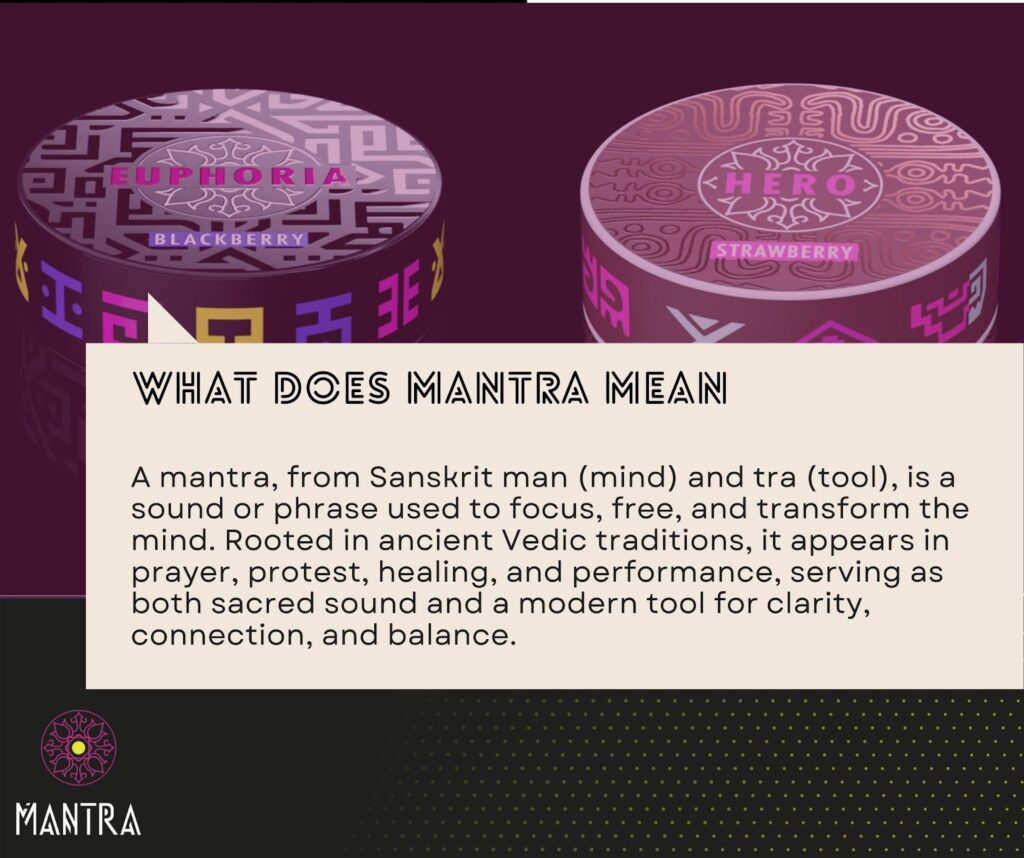
A mantra is not only a word, it’s a vessel. In its Sanskrit origin, man means “mind,” and tra means “tool” or “vehicle.” Put simply, a mantra is a tool for the mind, designed not to fill it, but to free it.
This ancient technology of sound traces back to the Vedas, the oldest Hindu scriptures, where mantras were used to invoke divine energies, sanctify rituals, and elevate consciousness.
Over time, mantras found their place across global spiritual traditions, from the meditative chants of Buddhism to the sacred incantations of indigenous healing ceremonies.
Yet mantra is not bound by religion. It has traveled across millennia and cultures, transforming from ancient chant to modern-day medicine for the distracted, the anxious, the awakening.
Today, mantras show up as:
- Prayer, inviting grace
- Protest, invoking change
- Performance, channeling presence
- Healing, restoring energetic harmony
Wherever humans seek clarity, connection, or transformation, mantra follows.
Definitions Across Contexts
**Religious:**In Hinduism and Buddhism, mantras are sacred sounds believed to hold the power to purify, protect, and awaken.
“Om Mani Padme Hum,” for example, invokes compassion and enlightenment, not only by meaning, but by vibration.
**Secular:**In modern self-help and wellness circles, mantras often appear as daily affirmations: “I am enough,” “I choose peace,” “This too shall pass.”
While these lack the ancient vibrational lineage, they serve as intentional cues to shift mindset and mood.
**Scientific:**Neuroscience now recognizes mantras as neural anchors, sound patterns that soothe the limbic system, quiet the monkey mind, and rewire repetitive thought loops.
Even brief repetition can enhance focus, reduce rumination, and promote emotional balance.
**Energetic:**Beyond logic, mantras are frequency. Whether whispered or sung, they resonate through the energetic body, tuning the nervous system like an instrument.
Sound healers often align mantras with chakras, knowing each syllable carries its own power.
In the ancient-future world we live in, mantra has become both medicine and metaphor. It’s no longer only a chant, it’s a code we live by.
Want to see how different types of people use mantra in their own practices? Keep reading.
Why Use a Mantra? Benefits Beyond Belief
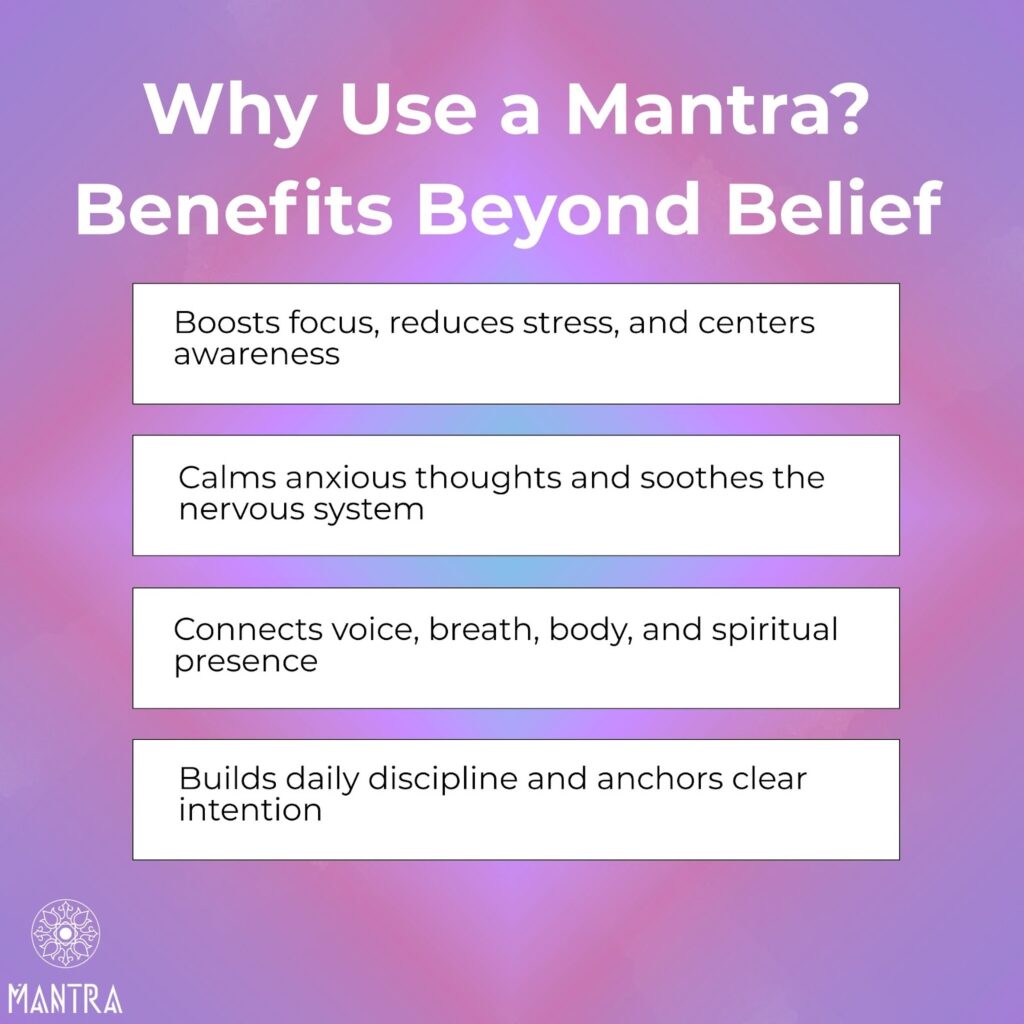
In a world flooded with noise, the simplicity of a mantra becomes revolutionary. At its core, mantra is not only about what you say; it’s about what you shift.
These ancient sound tools offer beyond spiritual symbolism; they deliver mental focus, emotional regulation, and energetic realignment.
Mental, Emotional, and Energetic Shifts
- Enhances concentration, reduces stress, and centers awarenessMantras are rhythm and repetition. Like the steady beat of a drum, they train the mind to return to the present. Even five minutes of mantra repetition can interrupt mental noise and create a field of calm.
- Calms rumination, anxiety, and trauma triggersBy activating parasympathetic responses and quieting the limbic system, mantras can interrupt looping thoughts and soothe the nervous system. Many trauma-informed healers now use them as somatic anchors in therapeutic settings.
- Links voice to breath, body, and spiritSpeaking or humming a mantra links inner voice to body rhythm, creating coherence across physical and energetic planes. It becomes a bridge between what you feel, what you say, and what you embody.
- Builds discipline and intentionA daily mantra practice, whether whispered before a meeting or chanted in a ceremony, trains you to show up for yourself. You’re not only saying words; you’re reinforcing who you choose to become.
Addressing the Skeptical Mind
Not everyone comes to mantras through mysticism. Some arrive through burnout, heartbreak, or the simple need to feel something. If that’s you, you’re not alone.
**What if I don’t believe in it?**That’s okay. Mantras don’t require belief. They require repetition. Like breath, their power is in the doing, not the dogma.
Even if you’re skeptical, the neural effects, calm, focus, and spaciousness, still occur.
**Is this only spiritual fluff?**Modern research shows that mantra repetition reduces cortisol, quiets the default mode network, and promotes neuroplasticity.
In simpler terms? It makes your brain more resilient and your heart more grounded.
**Am I doing it wrong?**There’s no wrong. Only resonance. While some traditions emphasize posture and pronunciation, what matters most is intention.
A quietly repeated “peace” can shift beyond a perfectly intoned Sanskrit syllable delivered without presence.
Do mantras still work if I don’t believe in them?
Yes. Belief is optional. Resonance is not.
Keep going, and you’ll see how personal, yet universal, mantra practice can become.
Which Mantra Is Right for You?

There’s no one-size-fits-all mantra, because there’s no one-size-fits-all path. Your mantra should meet you where you are: not as a prescription, but as a mirror.
Whether you seek stillness, healing, insight, or creative fire, the right mantra reflects your current intention and evolves as you do.
Personalized Uses of Mantra by Intention
Spiritual Seekers:
Mantras become sacred keys to stillness, unlocking meditative states where ego softens and essence expands.
Repeating a traditional sound like “So Hum” or “Om Namah Shivaya” can act as a devotional doorway to presence, grace, or divine remembrance.
Wellness Enthusiasts:
For those integrating mindfulness into modern life, mantras act as anchors. A phrase like “I am safe” or “Inhale calm, exhale tension” can bring the nervous system into harmony, whether you’re in traffic, on the mat, or journaling before bed.
Psychedelic Explorers:
In ceremonial space, mantras serve as anchors of intention and safety. A simple phrase repeated before a journey can carry you through waves of emotion and ego release.
It becomes a tether, something familiar to return to when everything else dissolves.
Can I create my own mantra before a mushroom trip?
Absolutely. In fact, it’s encouraged. Choose a phrase that holds personal power, like “I surrender to healing” or “Gratitude is my compass.”
What matters is emotional resonance, not perfection.
What if I do it wrong? There’s no wrong mantra, only disconnected ones. Trust your gut. If it feels grounding, it’s working.
Creative Minds:
Mantras help creatives bypass resistance and tap into flow. A mantra like “Clear channel” or “Create without fear” can quiet inner critics and open new pathways.
Think of it as a frequency tune-up before you write, paint, design, or dream.
Therapists & Coaches:
Practitioners often recommend mantras post-session as integration tools.
A trauma-informed mantra like “I am whole” or “I am here, now” can help clients reconnect with safety and self after doing deep emotional work.
We’ve seen customers craft their own mantras as part of healing journeys. Some arise mid-ceremony. Others emerge in quiet reflection.
Either way, your mantra is yours, and it’s powerful because you choose it.
Is Mantra Religious? Spiritual? Secular? All the Above.
Mantra is not defined by dogma; it’s defined by intention. While mantras are rooted in sacred traditions, their evolution has stretched across time, culture, and context.
They exist not only in temples, but in therapy rooms, breathwork circles, morning routines, and music festivals.
Yes, some mantras are thousands of years old, passed down through Hindu, Buddhist, and Tantric lineages.
These are sacred utterances, often in Sanskrit, believed to hold specific energetic frequencies and spiritual power.
But in today’s world, many find resonance in self-authored mantras, spoken in English, Spanish, or their native tongue.
A mantra like “I am light” or “Return to now” may not have ancient roots, but when repeated with intention, it can carry as much internal impact.
Does it still count as a mantra if it’s in my native language? Yes. Mantra is about resonance, not language. If it brings you clarity, safety, or transformation, it’s a mantra.
Cultural Sensitivity: Appreciation vs. Appropriation
With sacred tools comes responsibility. Many people worry, rightly, about whether using mantras from Eastern traditions without full context is disrespectful. It’s a valid concern.
The key is informed reverence:
- Don’t treat ancient mantras as trendy sound bites.
- Don’t misquote or misuse spiritual words for aesthetic.
- Do honor the origins when you use a traditional mantra.
- Do credit teachers or cultures that preserve these lineages.
Creating your own mantra doesn’t mean erasing tradition; it means personalizing your practice while honoring its roots.
A mantra is not only a borrowed phrase. It’s a living commitment, whispered by you, for you.
In the Mantra Dose universe, “mantra” is beyond a word; it’s a design principle, a sacred echo, a way of anchoring transformation into everyday life.
When to Use a Mantra: Daily Life to Deep Ceremony
Mantras are not only for monks or mystical mountaintops. They’re tools designed for modern minds, chaotic schedules, and sacred thresholds.
Whether you’re sipping tea at sunrise or navigating the kaleidoscope of a psychedelic journey, mantras offer something rare in a noisy world: inner signal clarity.
Everyday Mantra Moments
Mantras can be as sacred as a ritual or as simple as a whisper between meetings.
Here’s how people use them in daily life:
- Morning focus or journalingBegin your day with a mantra to prime your mindset. “Today, I lead with peace” or “I return to my center” transforms intention into atmosphere.
- Breathwork or yoga anchorIntegrating mantras into breathwork or asanas strengthens the connection between body and mind. One breath, one word, one focus.
- Work stress resetIn moments of overwhelm, a quiet internal chant like “I am steady” can recalibrate your nervous system without needing to leave your desk.
- Microdosing or integration promptsIn a microdosing protocol, pairing your dose with a mantra like “Expand with grace” turns a supplement into a sacred act. Later, journaling your mantra response deepens the integration.
Mantras in Psychedelic Ceremony
This is where mantras truly shine, as lifelines in altered states. In sacred plant medicine journeys, mantras act as anchors in the storm.
- Anchor during ego dissolutionWhen the self begins to dissolve, a familiar mantra can tether you to safety: “I am held,” “Trust the medicine,” or “Let go.”
- Aid emotional regulationIf intense feelings arise, reciting a mantra slows your breath and centers your awareness. It’s like returning to your breath, but with words.
- Bridge between visions and integrationA mantra received or used in a ceremony often becomes the thread you follow back into daily life. It’s not uncommon to hear someone say, “That mantra changed me.”
- Recite with reverence, not as a magic spellMantras are not spells or shortcuts. They don’t guarantee bliss or bypass discomfort. Used with intention, however, they guide you through both.
**Can mantras prevent a bad trip?**Not prevent, but prepare, anchor, and guide. A grounded mantra doesn’t shield you from the work, but it does remind you of your strength within it.
Using them improperly in altered statesRespect the practice. Avoid chanting mantras you don’t understand or borrowing sacred phrases casually. Instead, use language that feels personal, humble, and intentional.
We believe that every dose is a doorway, and every mantra is a map. Before the ceremony, we invite our community to choose or create a mantra that mirrors their intention.
What begins as a word often becomes a way of being.
How to Start Your Mantra Practice Today
Starting a mantra practice doesn’t require robes, rituals, or perfect pronunciation. All it takes is a word that means something to you, a few moments of intention, and a willingness to listen, not only to the sound, but to what it stirs within you.
Here’s how to begin:
1. Pick a word or phrase that resonates emotionallyLet your mantra emerge from your inner landscape. Choose something that feels alive in your body, not only clever in your head. Whether ancient like “Shanti” (peace) or personal like “I trust myself,” it should touch something real.
**2. Decide: Out loud, whisper, or internal repetition?**All are valid. Chanting aloud engages the voice and breath. Whispering creates intimacy. Repeating silently turns the mind into a sacred echo chamber. Try each and notice what brings the most resonance.
3. Link it with breath for deeper embodimentSync your mantra with the inhale and exhale. For example:
- Inhale: “I am”
- Exhale: “here now”
This breath-mantra rhythm deepens presence and dissolves distraction.
4. Use mala beads for counting or habit formationTraditionally, mantras are repeated 108 times using mala beads, a tactile way to build focus and form ritual. But don’t get stuck on numbers. One heartfelt repetition is worth beyond 100 hollow ones.
How long should I use the same mantra? As long as it serves you. Some mantras stay with you for years, others shift with your seasons.
You’ll know it’s time to change when the words feel empty or misaligned. Until then, trust the rhythm.
A mantra is not only something you do, it’s something you become. Start small. Stay curious. Let the practice reveal who you are when you’re not performing, pleasing, or pushing.
Mantra Dose: Medicine with a Mantra
We don’t only borrow the word mantra, we embody it. Every product we create is infused with the same intention, resonance, and reverence as a sacred chant.
From formulation to packaging, our offerings are beyond supplements; they’re rituals in physical form.
Each line serves a different intention, much like mantras themselves:
Hero Line
For those ready to journey inward. These potent blends are designed for guided psychedelic experiences, where deep introspection meets sacred exploration.
Hero supports you in going beyond the surface, with safety, intention, and support.
Euphoria Line
Crafted for microdosing and gentle awakening, Euphoria brings heart-centered presence to your daily rhythm.
Whether you’re healing, creating, or simply reconnecting with joy, this line supports emotional flow and somatic openness.
Nootropic Line
Designed for the focused, the visionary, and the high-functioning healer. These formulas promote clarity, flow state, and cognitive harmony, ideal for those who want to lead, build, and innovate with grounded energy.
Each capsule, gummy, or chocolate is handcrafted using organic inputs, clinically-informed dosing, and energetically-aligned formulations.
We treat our products like mantras, crafted with care, repeated with reverence, and designed to create lasting change.
Psychedelics can show you the door. Mantras remind you who you are when you walk through them.
Whether you’re preparing for a ceremony, microdosing for clarity, or simply seeking a sacred pause in a noisy world, Mantra Dose offers something beyond medicine.
We offer a mirror for your intention.
Mantra FAQs: Answering Your Inner Voice
Mantras are personal, powerful, and often misunderstood.
Below are some of the most common questions we hear from those just beginning, or deepening, their journey with these sacred sounds.
What is an example of a mantra?
Mantras can be ancient or modern, poetic or practical. A few examples include:
- “Om Mani Padme Hum,, A Buddhist mantra invoking compassion and awakening
- “I am that I am, A contemplative phrase used to explore identity and presence
- “Gratitude is my power, A deeply personal mantra birthed from healing and ceremony
Each of these carries energy. The one that resonates most? That’s the one to use.
What is your personal mantra?
There’s no right answer here. A personal mantra is something that arises from your lived experience.
Ask yourself: What do I need to remember right now?
Your mantra might be:
- “I am safe.”
- “This is temporary.”
- “Trust the unfolding.”
Whatever grounds you, uplifts you, or calls you forward, that’s your mantra.
What’s another word for mantra?
While “mantra” holds spiritual and cultural weight, similar concepts exist across contexts:
- Affirmation – A positive statement to reprogram beliefs
- Chant – A rhythmic or musical repetition of words or syllables
- Intention – A conscious direction for thought or energy
- Incantation – A spoken phrase believed to influence reality
The difference lies not in the word, but in the way you use it.
What does mantra mean in the Bible?
While the term “mantra” doesn’t appear in Biblical texts, similar practices exist. The Psalms, for example, often repeat phrases like “His love endures forever”, used in meditative and musical worship.
Early Christian mystics also practiced contemplative prayer, repeating short sacred phrases to enter union with God.
At its core, mantra is not bound by religion; it’s a timeless technique for remembering what matters most.